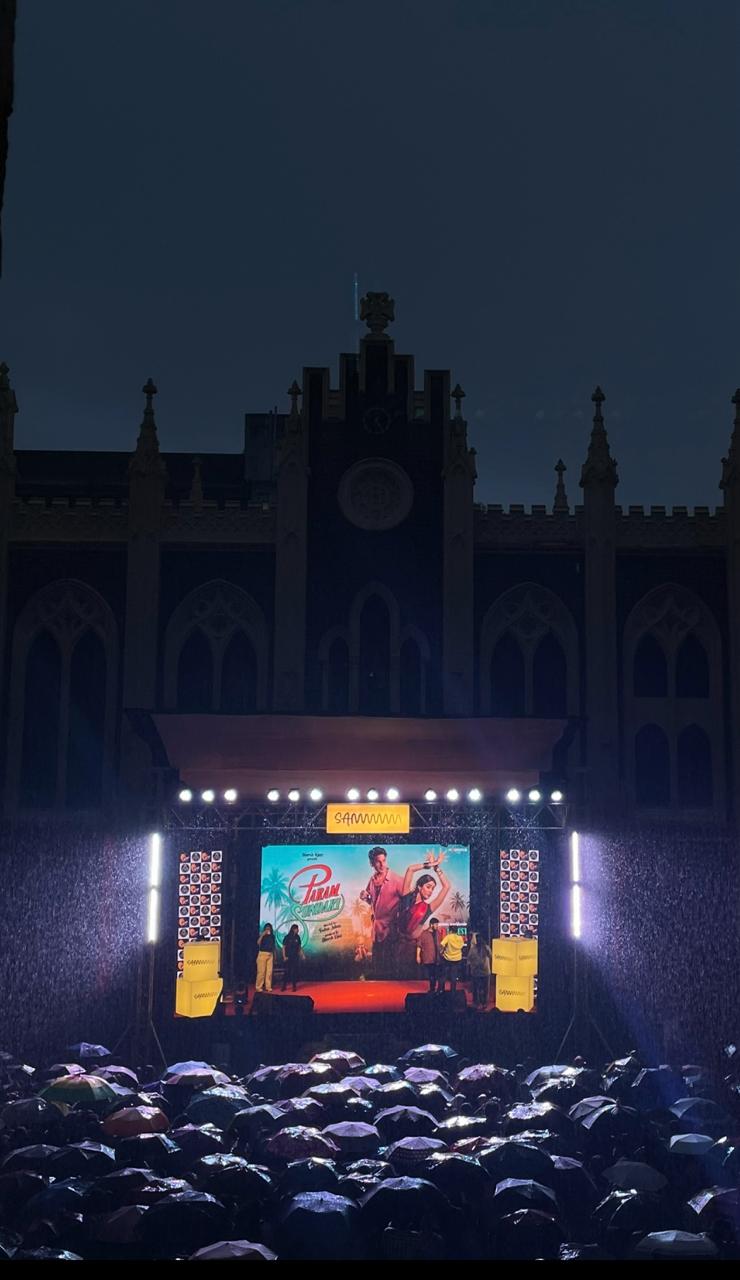
Rain.
The earthy smell, the wind brushing against your face, and the droplets that find you no matter how hard you try to escape them. Much like the wave of nostalgia that arrives, uninvited and unstoppable, with the season itself.
In Wake Up Sid, when Sid says, “Tumhe Bombay baarish mein dekhna chahiye. Man, Bombay monsoons are to die for,” the line strikes a chord with anyone who has ever romanticised the rains that soften an otherwise relentless city.
But for every Xavierite, monsoon never arrives alone. It brings with it Malhar.
A word synonymous with rain, and not just in language.
Most eyes witness only the downpour: the three days of the fest as it unfolds in all its grandeur. But like rain, the onset of Malhar is a gradual process, slow yet beautifully ever-changing.
For a fest that reaches its climax in August, its origins lie buried in the summer months. Forms, GDs, ideation meetings. Long before the first drizzles arrive, the sky already begins to change.
Like the rains, Malhar follows a cycle of its own, though not an obvious one. Every year, from a sea of students, only a few find their way into the workforce. The heat of the competition is impossible to miss. The best-suited ones rise from the masses like droplets drawn towards the sky, gathering into clouds on the horizon.
A single droplet, by itself, does not account for much. Neither does a volunteer, an OG, OC, or even the CP all alone. But together, these droplets become a cloud. Individuals become a force. They gather into vast formations of imagination, ideas, strategies, and ambition.
Just as vapour does not converge into a single cloud, the workforce does not become a single entity. There are many clouds, many departments, each carrying a different responsibility. Each tasked with nourishing a different part of the landscape, much like every department overseeing its own area of expertise.
The clouds become symbols of collective energy. They spend months building the festival piece by piece, hour by hour, day after day. Sometimes they rumble with disagreements. Sometimes they crackle with excitement. Sometimes they threaten to rupture beneath the sheer weight of expectations.
And when that anticipation becomes too great to contain, the first drizzles arrive: the pre-events. One cloud at a time. One department at a time.
They are gentle showers that announce what is to come, bringing Malhar back into conversations and consciousness. The first signs of changing weather. The first forecasts. The reminders that umbrellas and raincoats must find their way back out of the dusty cupboards, and into people's bags.
Then comes the moment everything has been building towards.
When the momentum reaches a point of expression, the clouds finally burst.
Not separately, but together.
The main days of Malhar.
Thousands of droplets moving in a shared rhythm, each dependent on the others, each contributing to something far greater than itself. The sky empties itself entirely, and for three days, the city feels the impact.
The fate of every droplet is different. Similarly, not every event is a triumph, and not every idea lands perfectly. Some are met with thunderous applause, while others are received with constructive criticism and inspire introspection. Occasionally, lightning cuts across the sky. A eureka moment, a stroke of brilliance that illuminates everything around it, even if only for a fleeting instant. It is a journey of hits and misses, of storms and stillness.
But rain was never meant to fall uniformly. Everyone sees it differently.
Some wait desperately for the first drop to touch their skin. Others prefer watching it from the comfort of their homes, with chai and pakodas in hand. And then some have simply not experienced the phenomenon yet.
The same is true of Malhar.
But Malhar is so much more. It transforms. Plants become trees, and trees grow greener. In the same way, people change too. Both the view and the point of view emerge altered.
The person who enters the world of Malhar in April rarely resembles the person who leaves it in August. Somewhere between the meetings, the deadlines, the victories, the failures, the exhaustion, the sleep deprivation, and the exhilaration, change occurs. Some visible. Some internal, marked by deep realisations.
It is growth, both personal and collective.
The rain becomes a testament to the beauty hidden within chaos. It does not fall in one place alone; it spreads everywhere, touching lives far beyond where it began.
Malhar does the same.
Its impact extends beyond the campus gates and beyond the three days of the festival. It lives on in memories, friendships, careers, inside jokes, lessons learned, and stories people continue carrying long after the fest ends.
And when the curtains finally fall, returning to the monotony of ordinary college life feels strangely difficult. As though something has been drained from the air. As though the sea no longer surprises you. As though a city that buzzed with possibilities is brought to a standstill.
But that feeling never lasts forever, because clouds disperse after the storm only to gather again.
And so does the spirit of Malhar, finding a home in every new batch that dares to rise, converge, and, eventually, pour.